World Model Engine
Manages characters, timelines, locations, visual style, narrative rules, and continuity constraints.
Autonomous Transmedia Layer for AI Studios
The AI Production Technology Layer for the Next Era of Global Cinema
ATLAS helps studios, creators, and IP owners build cinematic worlds through AI-native production, world models, synthetic VFX, asset registration, compute orchestration, and programmable revenue settlement.
Industry Shift
AI video generation is no longer only about producing isolated short clips. The next frontier is the construction of persistent cinematic worlds: characters, scenes, voices, styles, prompts, rights, and revenue flows that can be reused, licensed, distributed, and governed.
ATLAS is positioned at the infrastructure layer beneath that shift. It connects creative intent, production agents, transmedia assets, rights records, compute networks, and settlement logic into a full-stack system for AI-native cinema.
Platform
ATLAS organizes the film-production cycle into a protocol network that spans generation, assetization, licensing, studio collaboration, and settlement.
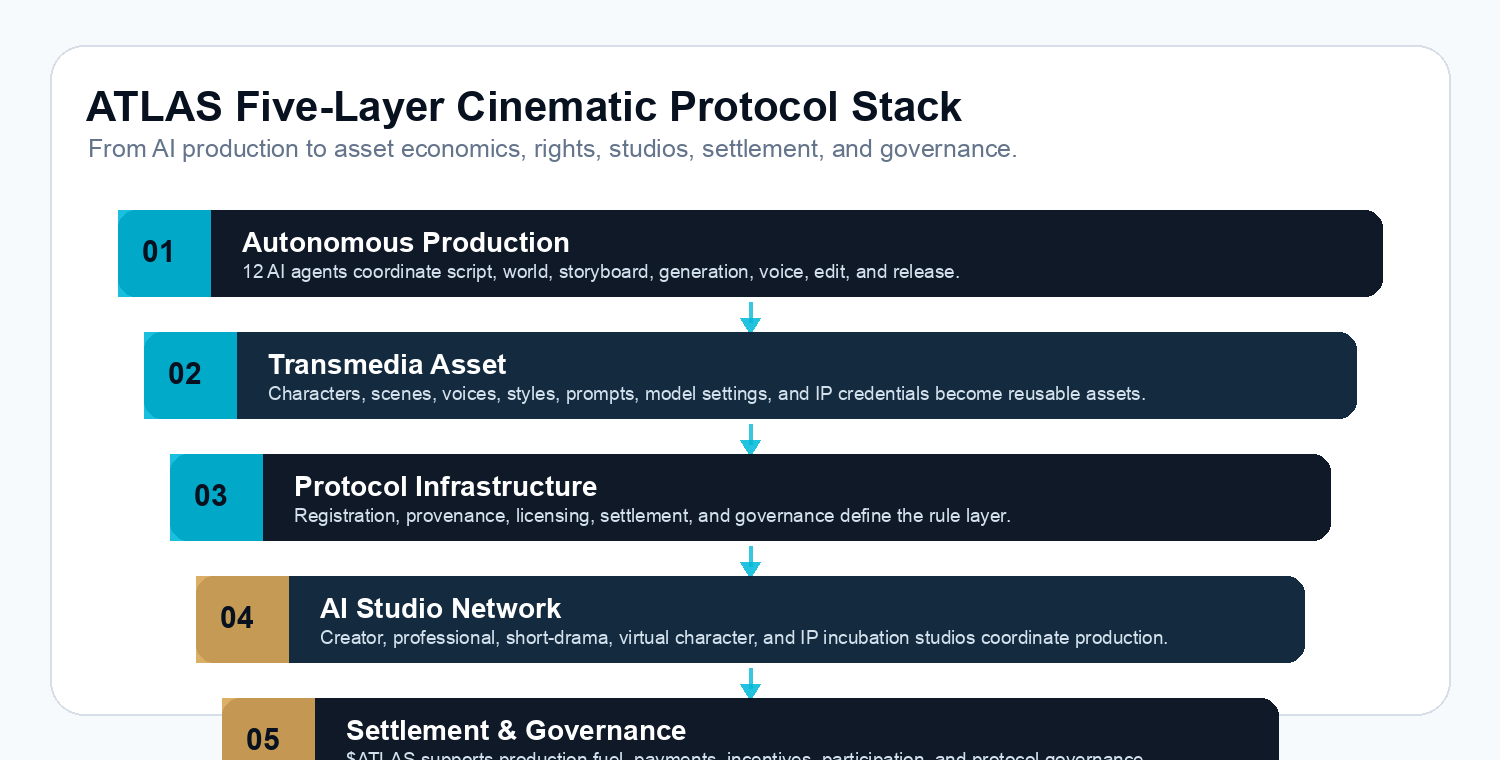
AI agents coordinate script, storyboard, generation, voice, editing, and release workflows.
Characters, scenes, voices, styles, prompts, and model settings become reusable assets.
Registration, provenance, licensing, verification, and revenue sharing define the rule layer.
Creator, professional, short-drama, virtual-character, and IP incubation studios coordinate production.
$ATLAS supports production fuel, settlement, incentives, participation, and protocol governance.
Enterprise Studio
ATLAS Enterprise Studio is designed for film studios, streaming platforms, IP groups, advertising networks, and game-to-film teams that require secure production infrastructure rather than a lightweight creator tool.
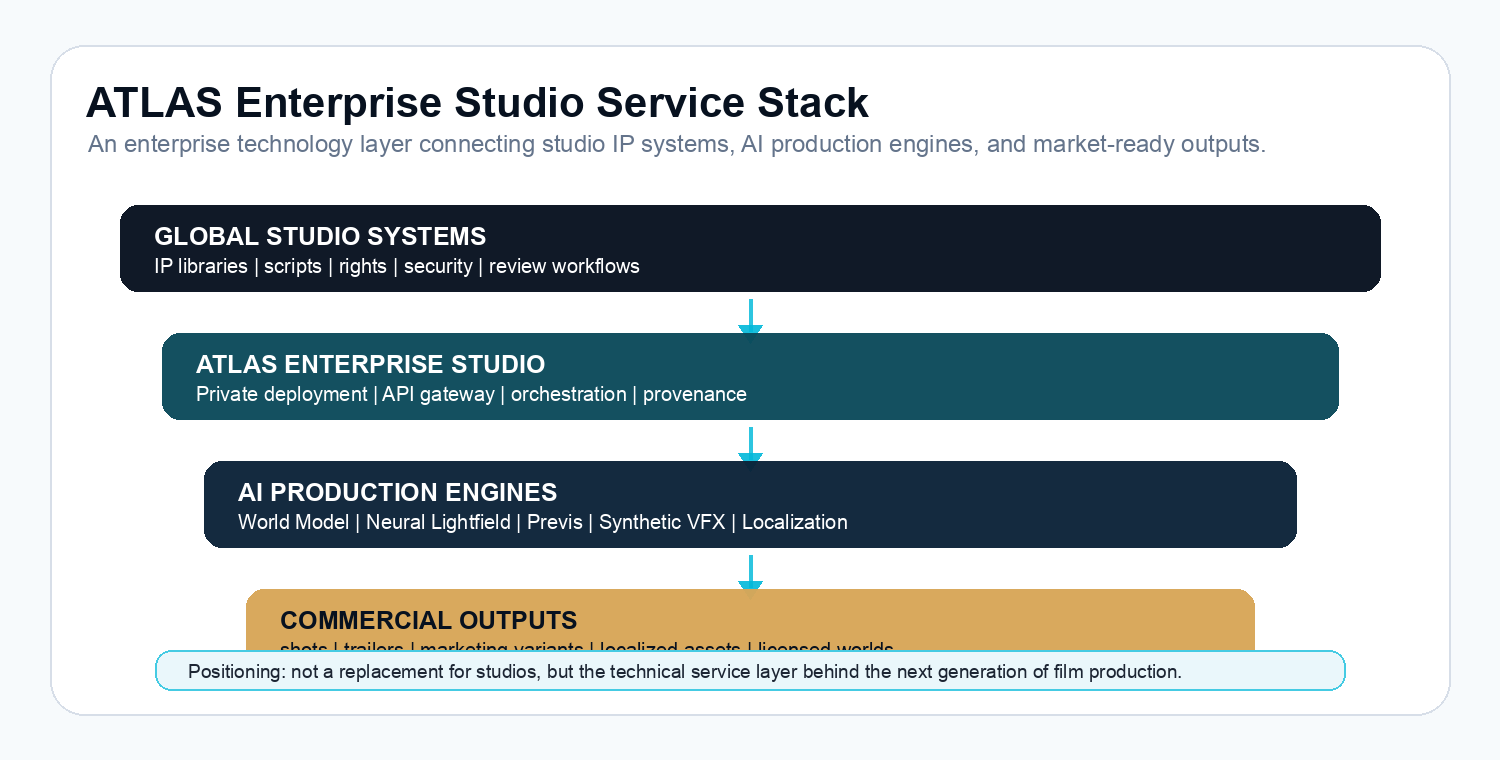
Manages characters, timelines, locations, visual style, narrative rules, and continuity constraints.
Generates cinematic lighting, materials, scenes, camera motion, atmosphere, and continuity.
Turns scripts and briefs into storyboards, previs sequences, shot options, and action-scene tests.
Records characters, scenes, voices, styles, prompts, permissions, and usage history.
Creates multilingual subtitles, dubbing plans, trailer variants, posters, and market-specific campaigns.
Schedules B200 / GB200-class compute for inference, rendering, generation, routing, and cost control.
World Model
ATLAS treats characters, settings, timelines, styles, rights, and revenue rules as computable structures. A world model can support films, series, animation, games, marketing, licensed derivatives, and community participation without losing continuity.
Relationships, growth arcs, appearance consistency, behavioral rules, and voice identity.
World history, event sequence, parallel timelines, prequel logic, and continuity constraints.
Locations, geography, architecture, spatial rules, and environmental atmosphere.
Color, cinematography, lens language, material style, lighting logic, and composition rules.
Character rights, scene rights, usage permissions, derivative rights, and commercial scope.
Allocation across rights holders, creators, model providers, distributors, and contributors.
Neural Lightfield
Neural Lightfield Engine is a cinematic neural rendering system for lighting, shadow, material, camera movement, depth, atmosphere, and scene continuity. It is meant to compress repetitive, high-iteration, scene-heavy production work while preserving studio review and editorial control.
Asset Economy
ATLAS connects creative production to asset registration, licensing, distribution, revenue settlement, and governance so AI-native film assets can compound beyond a single output.
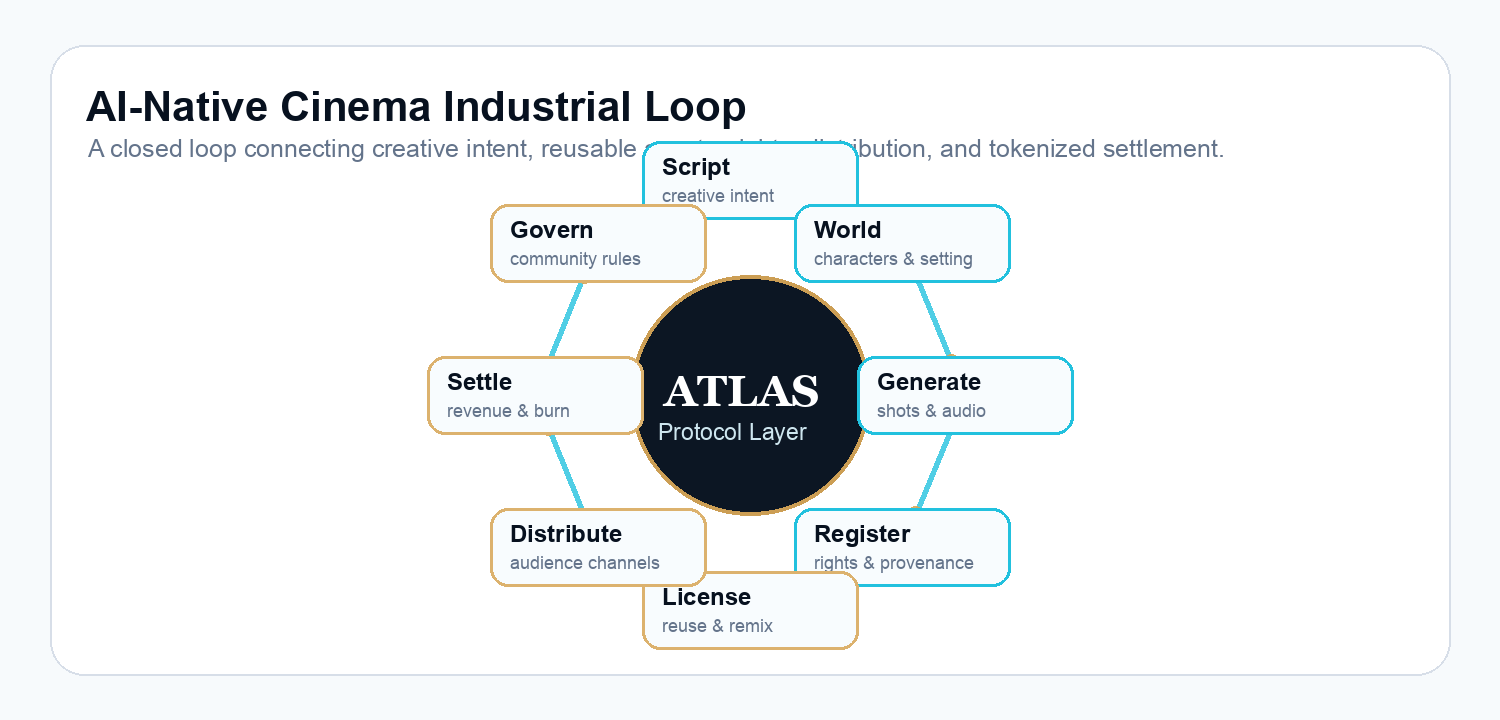
Scripts, worlds, characters, shots, voices, and styles are generated or refined.
Assets, prompts, model settings, and usage records receive provenance metadata.
Rights rules define reuse, remixing, derivative creation, and commercial boundaries.
Revenue allocation can flow across creators, IP owners, studios, models, and distributors.
Roadmap
Validate the core studio workflow, world-model structure, and production-agent loop.
Launch reusable cinematic assets, licensing flows, and creator-facing studio modules.
Connect generation workloads to compute orchestration, settlement, and provenance records.
Expand from production infrastructure into transmedia distribution, studio networks, and governance.
Whitepaper
The whitepaper defines ATLAS as protocol-level infrastructure for the AI Native Cinema Industry, including its five-layer network, enterprise studio strategy, asset economy, governance model, and roadmap.